
Han L. J. van der Maas
Professor, University of Amsterdam, and External Faculty, Santa Fe Institute
Han L. J. van der Maas is Professor of Psychological Methods in the Department of Psychology at the University of Amsterdam and Distinguished Research Professor of Complex Systems in the Social and Behavioral Sciences. He is also an External Faculty Member of the Santa Fe Institute and a Principal Investigator and Board Member of the Institute of Advanced Study at the UvA.
Van der Maas received his PhD in developmental psychology in 1993, focusing on phase transitions in cognitive development. He joined the faculty of the University of Amsterdam, becoming full professor in 2003 and chair of the Psychological Methods Group in 2005. He has held leadership positions as Director of the Graduate School and Director of Research.
In 2009 he founded Oefenweb.nl, a spin-off company that developed a game-based adaptive child monitoring system, now part of Prowise.com. His research focuses on formalizing and testing psychological theories of cognition, expertise, development, attitudes, and intelligence. In 2022, he received an ERC advanced grant to study cascading transitions in psychosocial systems.
SFI Press Books
Foundational Papers in Complexity Science presents the first unified charting of the full territory of complexity science—an essential resource for navigating the modern world.
This project maps the development of complex-systems science through eighty-nine revolutionary works originally published between 1922 and 2000. Curated by SFI President David C. Krakauer, each seminal paper is introduced and placed into its historical context, with enduring insights discussed by leading contemporary complexity scientists.
These four volumes are a product of collective intelligence. More than a compilation, Foundational Papers represents large-scale collaboration within the SFI community—brilliant thinkers who have contextualized the work that shaped their own research, resulting in a sparkling demonstration of how complexity shatters the usual scientific divisions and a look back at the path we’ve followed in order to gain a clearer view of what lies ahead.
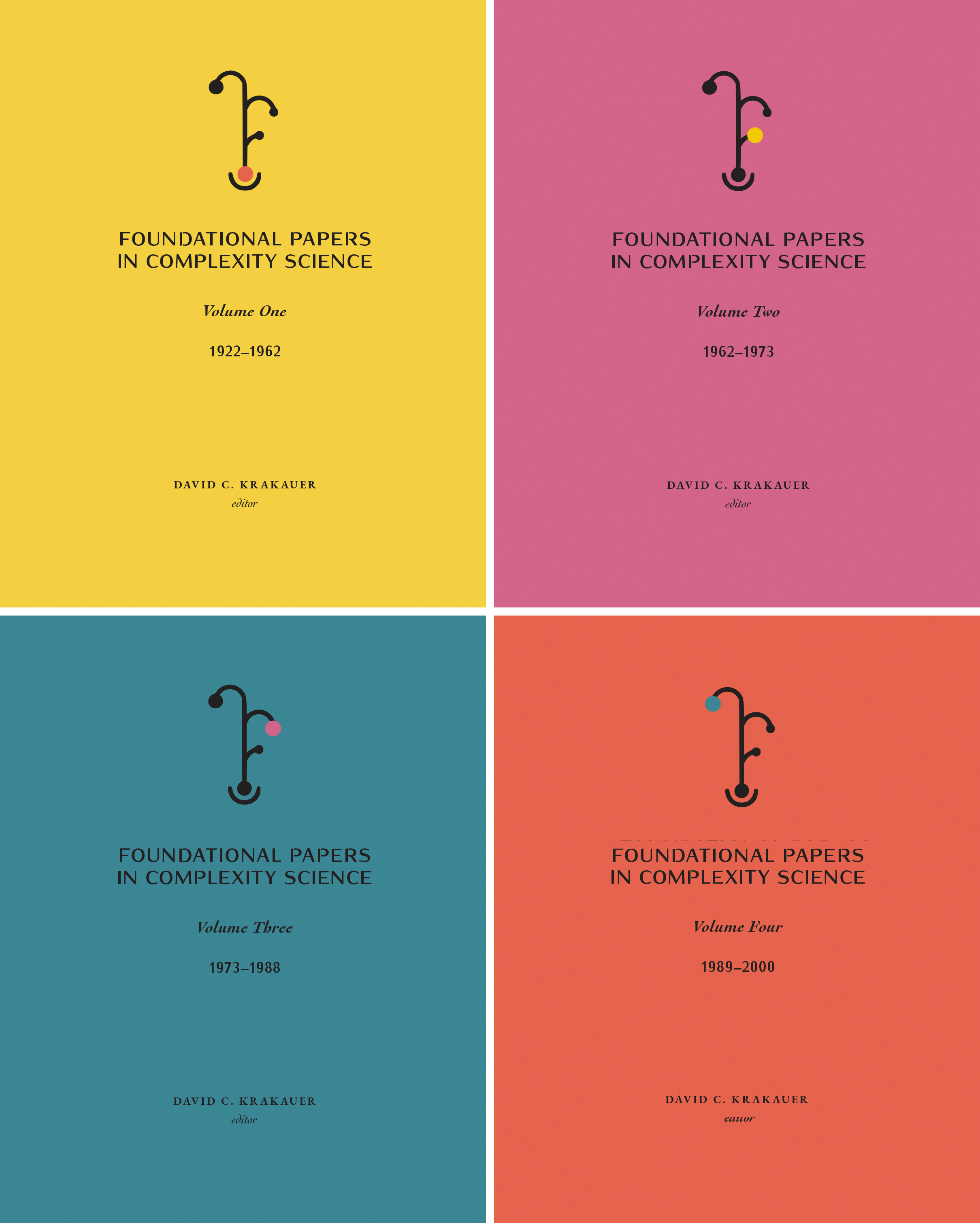
Volume I spans the turbulent years from 1922 to 1962. Across several decades of war, runaway technological invention, and economic upheaval, complexity science emerges through the integration of ideas from evolution, computation, dynamics, and statistical physics.
Volume 2 examines the utopian–dystopian years from 1962 to 1973: a decade of global instability, social revolution, space exploration, and growing ecological awareness. Complexity science challenges our understanding of prediction, control, and uncertainty.
Volume 3 describes the maturing of complexity science in the age of democratized computing. Mini-computers and personal computers supporting computer graphics, simulation environments, and numerical mathematics, intersect with nonlinear dynamics, evolutionary theory, and statistical physics. This culminates in new models and theories—from autopoiesis to synergetics, cellular automata to agent-based models—and their many applications, including ecological resilience, complex materials, the origin of life, and climate dynamics.
Volume 4 marks the era of the global internet, ubiquitous computing, and multiple network revolutions. As complexity science matures, unifying frameworks emerge, including connectionism, scaling theory, new models and theories of transmission and contagion, and various forms of biologically inspired computing. The application of mechanisms of decentralized knowledge production to society and culture transforms our understanding of socio-economic and cultural systems.
Humans are the ultimate complex systems. In this monograph intended for psychologists and social scientists interested in modeling psychological processes, Han L. J. van der Maas argues that we can only succeed in exploring the psychological system by understanding its complexity. By applying the tools of complexity science to psychology, researchers and practitioners can achieve desperately needed breakthroughs in the social sciences.
The book has three primary objectives: to provide a comprehensive overview of complex-systems research, with a particular emphasis on its applications in psychology and the social sciences; to provide skills for complex-systems research; and to foster critical thinking regarding the potential applications of complex systems in psychology. Readers should have a basic understanding of mathematics and knowledge of the programming language R.
Complex-Systems Research in Psychology explores a range of topics, including chaos, bifurcation, and self-organization in psychological processes, psychological network analysis, as well as agent-based modeling of social processes. It offers applications in various areas of psychology, such as perception, depression, addiction, cognitive development, and polarization.
The electronic version of this volume is freely available and can be viewed at:
https://santafeinstitute.github.io/ComplexPsych/
If we could rewind the tape of the Earth’s deep history back to the beginning and start the world anew—would social behavior arise yet again?
While the study of origins is foundational to many scientific fields, such as physics and biology, it has rarely been pursued in the social sciences. Yet knowledge of something’s origins often gives us new insights into the present.
In Ex Machina, John H. Miller introduces a methodology for exploring systems of adaptive, interacting, choice-making agents, and uses this approach to identify conditions sufficient for the emergence of social behavior. Miller combines ideas from biology, computation, game theory, and the social sciences to evolve a set of interacting automata from asocial to social behavior.
Readers will learn how systems of simple adaptive agents—seemingly locked into an asocial morass—can be rapidly transformed into a bountiful social world driven only by a series of small evolutionary changes. Such unexpected revolutions by evolution may provide an important clue to the emergence of social life.
To fully understand not only the past, but also the trajectories, of human societies, we need a more dynamic view of human social systems. Agent-based modeling (ABM), which can create fine-scale models of behavior over time and space, may reveal important, general patterns of human activity. Agent-Based Modeling for Archaeology is the first ABM textbook designed for researchers studying the human past. Appropriate for scholars from archaeology, the digital humanities, and other social sciences, this book offers novices and more experienced ABM researchers a modular approach to learning ABM and using it effectively.
Readers will find the necessary background, discussion of modeling techniques and traps, references, and algorithms to use ABM in their own work. They will also find engaging examples of how other scholars have applied ABM, ranging from the study of the intercontinental migration pathways of early hominins, to the weather–crop–population cycles of the American Southwest, to the trade networks of Ancient Rome. This textbook provides the foundations needed to simulate the complexity of past human societies, offering researchers a richer understanding of the past—and likely future—of our species.
News
On December 19, the SFI Press published Volume 4 of Foundational Papers in Complexity Science. Following the publication of Volumes 1 and 2 in May and Volume 3 in September, this concluding book contains papers published between 1989 and 2000 — an era when complex-systems science had become a fledgling field of study in its own right. Hardcover and paperback versions of each book are available globally at cost; they are not available as ebooks due to electronic reprint rights.
We live in a complex world — one that is increasingly connected, evolving, technological, volatile, and potentially poised for catastrophe. And yet we continue to treat the world as if it were simple. Our dominant frameworks are still linear, unchanging, and disconnected, assuming Earth’s resources are infinitely exploitable. Complexity science offers a paradigm-shifting approach.
To SFI External Professor Han van der Maas, psychology is the most fascinating science of all. It’s also one he sees as facing multiple crises — crises of theory, replication, and measurement.
The Santa Fe Institute is gifting a set of Foundational Papers in Complexity Science books to each recipient of the Complex System Society’s upcoming Emerging Awards. The three winners will be announced during the next Conference on Complex Systems in Exeter, UK, in September.
When Claude Shannon wrote “A Mathematical Theory of Communication” in 1948, he was known as a mathematician and an electrical engineer. From this extraordinarily influential paper — cited more than 155,000 times — he would come to be called the “father of information theory.” Today, we see in him the hallmarks of an early complexity scientist.
The more we learn about the past, the more we come to understand that ancient societies share some striking similarities to our own. From the first waves of migration out of Africa to the Ancestral Pueblo, the peoples of the past created art, migrated to new lands, fought wars, raised families, and exploited natural resources for housing, food, and tools—just like we do.
The Complex World, originally published in Volume 1 of Foundational Papers in Complexity Science, presents an entirely new framing of nature, of the human role in the natural and technological worlds, and what it means to prosper on a living planet.
We live in a complex world—meaning one that is increasingly connected, evolving, technological, volatile, and potentially poised for catastrophe. And yet we continue to treat the world as if it were simple: linear, unchanging, disconnected, and infinitely exploitable.
Complexity science is an approach to understanding and surviving in a complex world. In this concise and comprehensive introduction, Santa Fe Institute President David C. Krakauer traces the roots of complexity science back to the nineteenth-century science of machines—evolved and engineered—into the twentieth-century science of emergent systems.
By combining insights from evolution, computation, nonlinear dynamics, and statistical physics, complexity science provides the first scientific framework for understanding the purposeful universe.