
New Book: The Economy as an Evolving Complex System IV
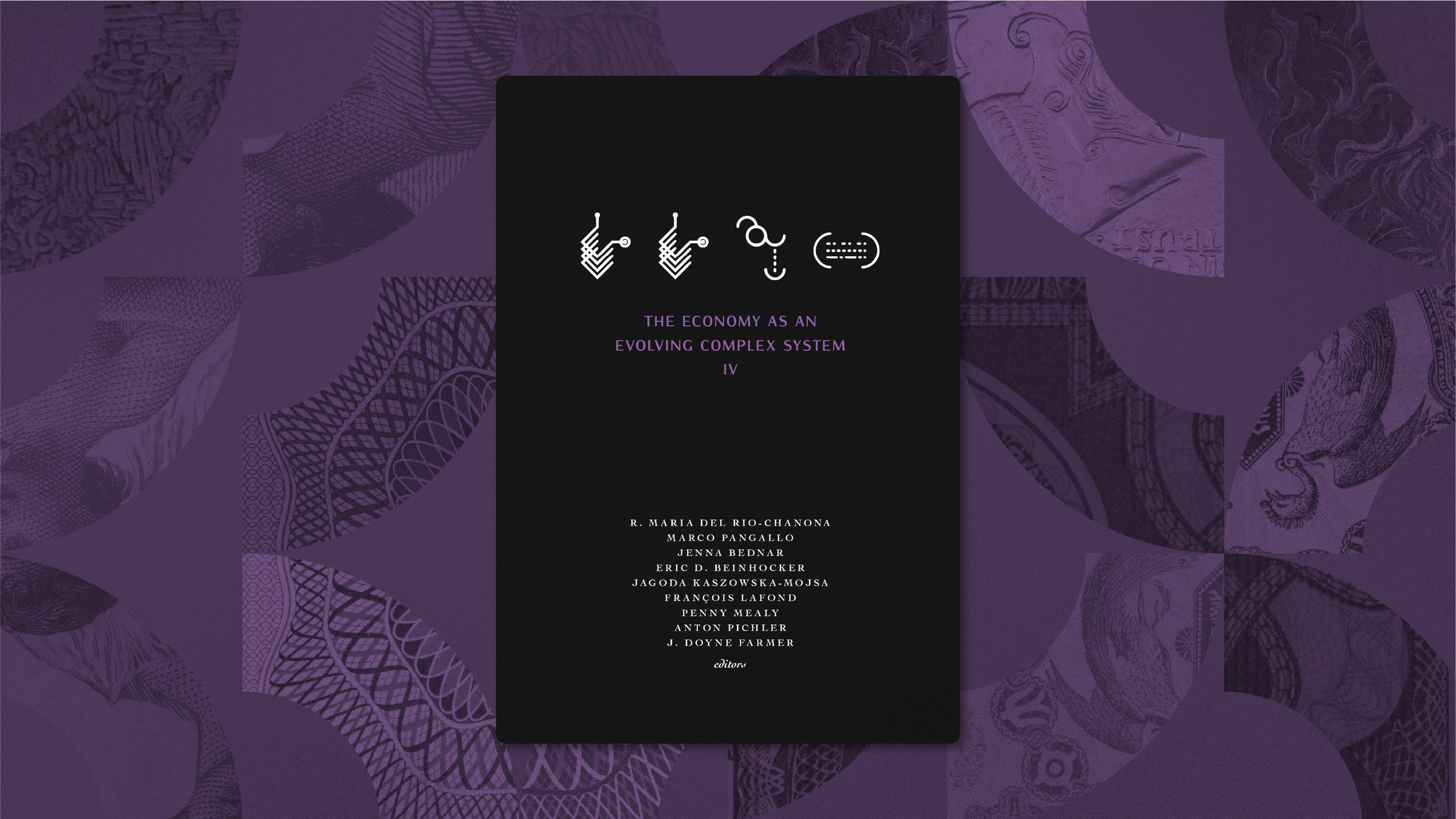
The Economy as an Evolving Complex System IV
Edited by R. Maria del Rio-Chanona, Marco Pangallo, Jenna Bednar, Eric D. Beinhocker, Jagoda Kaszowska-Mojsa, François Lafond, Penny Mealy, Anton Pichler, and J. Doyne Farmer
$13.99 (Paperback)
Publisher and imprint: The SFI Press Seminar Series
600 pages (volume I); 570 pages (Volume II)
Paperback ISBN: 978-1-947864-68-9 (volume I); 978-1-947864-65-8 (volume II)
Publication Date: February 12, 2026
Available on Amazon.com
Think of the economy as a giant web where every person, company, and country is linked. When something big happens — a pandemic, the rise of artificial intelligence, or a climate-driven disaster — it doesn’t just hit one strand. The shock ripples across the entire web, creating effects in real time that are hard to predict.
That’s the central theme of The Economy as an Evolving Complex System IV (SFI Press, 2026), the newest volumes in a series launched at the Santa Fe Institute nearly four decades ago to rethink economics through the lens of complexity science. Rather than assuming markets always balance neatly, these books treat the economy as a living system that grows, changes, and reacts in ways that are hard to predict.
“The economy isn’t a machine that always returns to balance,” says R. Maria del Rio-Chanona, co-editor and an assistant professor in the computational economics and finance section at University College London. “It’s a complex system where shocks can spread quickly, and our goal is to give policymakers tools that reflect that reality.”
The project’s thirty-one chapters, divided between two volumes, act as a guide for researchers, students, and policymakers seeking better ways to understand and manage an increasingly turbulent economy, highlighting how a new generation of tools for capturing complexity are reaching maturity and moving into practice. Agent-based models, for instance, use data on workers, firms, and households to simulate how economies behave under stress. The volumes show how these models are no longer confined to theory: policymakers and central banks are already using them to forecast GDP during crises, manage housing bubbles, and prepare workers for the AI transition.
“Agent-based models and network tools allow us to see things standard equations miss,” says co-editor Marco Pangallo, a research scientist at the CENTAI Institute. “They capture diversity and feedback loops and let us realistically test what might happen in complex situations. That’s what makes them so powerful for designing real-world policy.”
The emphasis on application is what makes the new books stand apart from their predecessors, according to co-editor François Lafond, an economist at the University of Oxford who authored a chapter on forecasting technological progress. “Earlier volumes were more about proving that complexity ideas could work in principle,” he says. “These show how they’re being used today by central banks, regulators, and researchers to tackle real problems.”
For the authors, the most exciting aspect of this shift from theory to practice is that the field can now be judged by objective results rather than abstract debates. With richer data, stronger computing power, and realistic synthetic populations of households and firms, researchers can finally test whether their models outperform traditional ones. They hope the books will give readers confidence that methods from complexity economics are ready to shape real decisions about the economy’s future.
“For years it was all theory,” Lafond says. “Now we can simulate supply chains or labor markets, let the models run, and then check against reality. The world is messy, and so are our models — but that’s exactly why they work.”