
David C. Krakauer
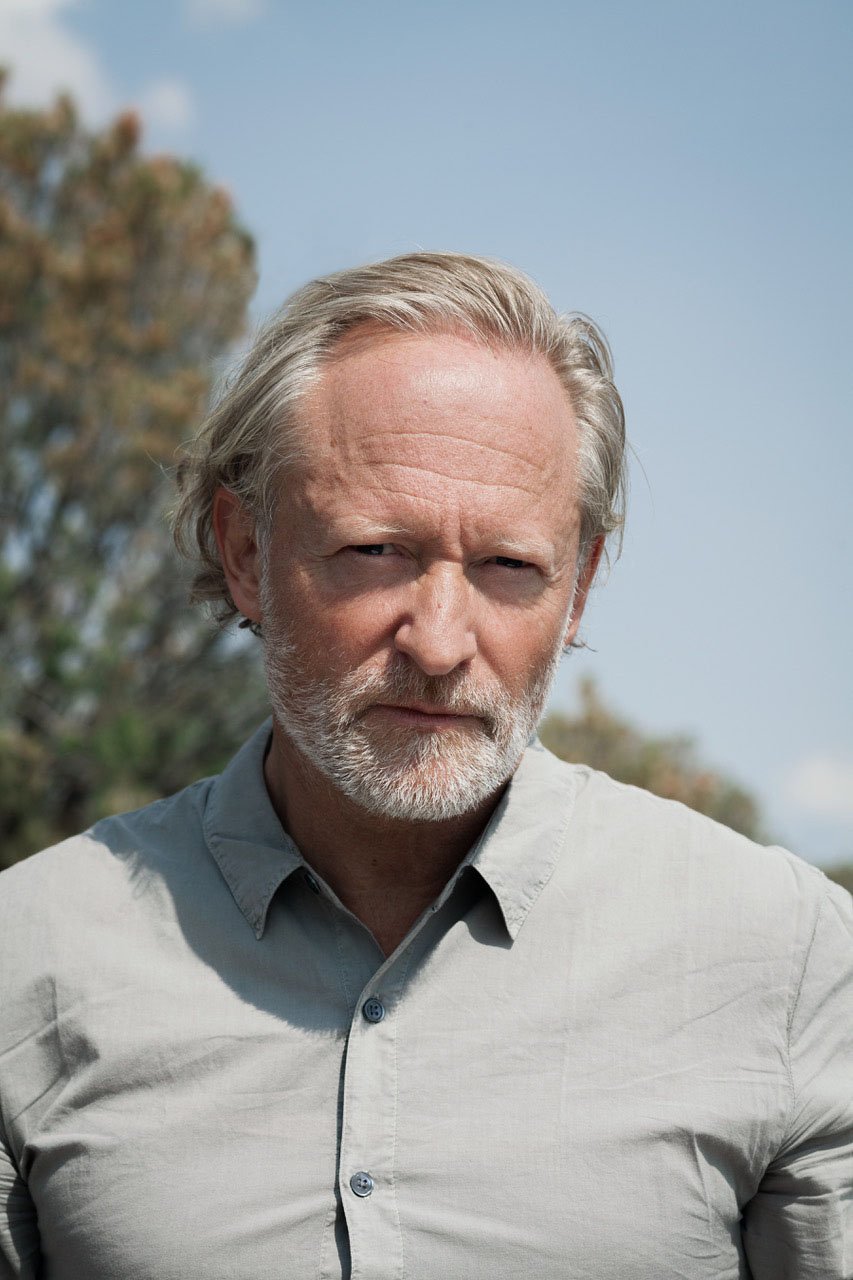
David C. Krakauer
President, Santa Fe Institute
David Krakauer is the President and William H. Miller Professor of Complex Systems of the Santa Fe Institute, and Editor in Chief of the SFI Press.
SFI Press Books
COVID-19 is the virus that proved the fragility of the world. It took only the simplest form of life to shake the connectivity and dependency of society. This book is a real-time record and recommendation from a community of complexity scientists reacting to the pandemic. Through nontechnical articles, interviews, and discussions spanning the early days of the pandemic through the fall of 2021, researchers seek ways to stay responsive to complexity when every force conspires toward simplicity. The Complex Alternative encompasses immunology, epidemiology, psychology, inequality, and collapse. It is an effort to preserve perspective at a time when partiality seeks dominion.
Edited by David C. Krakauer and Geoffrey West, this book features the thoughts of more than sixty members of the Santa Fe Institute’s research community on the future of complexity science and the broader significance of science in the twenty-first century.
This volume is a record of the Santa Fe Institute’s second InterPlanetary Festival, nicknamed Stardust, held in Santa Fe, New Mexico, in June of 2019. The InterPlanetary Festival fuses an exploration of complex systems and technological innovation with music, film, art, food, drinks, and more.
During the Summer of Stardust, as the world observed the fiftieth anniversary of the momentous Apollo 11 Moon landing, the Festival celebrated human ingenuity and pondered what the next half-century might hold. Conversations centered on building other worlds — imaginatively in literature, experimentally in simulation and games, and literally in architectural design. Attendees and panelists wrestled with topics as wide-ranging as time, the future of cities, and the meaning of intelligence.
In this book, transcripts of the Festival panel discussions, each paired with new introductions by contributors including physicist Sean Carroll, poet, artist, and curator Anaïs Duplan, and speculative-fiction writer Rebecca Roanhorse, commemorate the creativity and insight generated at this one-of-a-kind cosmic event.
This volume is a record of the proceedings of the first InterPlanetary Festival, held in Santa Fe, New Mexico, in June of 2018 by the Santa Fe Institute, birthplace of complexity science.
An annual free public event, the InterPlanetary Festival combines an exploration of complexity science and technological innovation with a summer festival full of music, film, art, food, drinks, and more.
The Festival is just one aspect of the broader InterPlanetary Project, which is equal parts conference, festival, and research program. The first project of its kind to combine celebration with experimentation, and conversation with analysis, the InterPlanetary Project seeks nothing less than a whole-planet project—beyond borders, beyond politics, beyond economics—to activate the collective intelligence of our first planet: Earth.
Over the last three decades, the Santa Fe Institute and its network of researchers have been pursuing a revolution in science.
Ignoring the boundaries of disciplines and schools and searching for novel fundamental ideas, theories, and practices, this international community integrates the full range of scientific inquiries that will help us to understand and survive on a complex planet.
This volume collects essays from the past thirty years of research, in which contributors explain in clear and accessible language many of the deepest challenges and insights of complexity science.
Explore the evolution of complex systems science with chapters from Nobel Laureates Murray Gell-Mann and Kenneth Arrow, as well as numerous pioneering complexity researchers, including John Holland, Brian Arthur, Robert May, Richard Lewontin, Jennifer Dunne, and Geoffrey West.
What is history anyway? Most people would say it’s what happened in the past, but how far back does the past extend? To the first written sources? To what other forms of evidence reveal about pre-literate civilizations? What does that term mean—an empire, a nation, a city, a village, a family, a lonely hermit somewhere? Why stop with people: shouldn’t history also comprise the environment in which they exist, and if so on what scale and how far back? And as long as we’re headed in that direction, why stop with the earth and the solar system? Why not go all the way back to the Big Bang itself?
There’s obviously no consensus on how to answer these questions, but even asking them raises another set of questions about history: who should be doing it? Traditionally trained historians, for whom archives are the only significant source? Historians willing to go beyond archives, who must therefore rely on, and to some extent themselves become, psychologists, sociologists, anthropologists, archeologists? But if they’re also going to take environments into account, don’t they also have to know something about climatology, biology, paleontology, geology, and even astronomy? And how can they do that without knowing some basic physics, chemistry, and mathematics?
This inaugural volume of the SFI Press (the new publishing arm of the Santa Fe Institute) attempts to address these questions via thoughtful essays on history written by distinguished scholars—including Nobel laureate Murray Gell-Mann—from across a wide range of fields.
News
Think of the economy as a giant web where every person, company, and country is linked. When something big happens — a pandemic, the rise of artificial intelligence, or a climate-driven disaster — it doesn’t just hit one strand. The shock ripples across the entire web, creating effects in real time that are hard to predict.
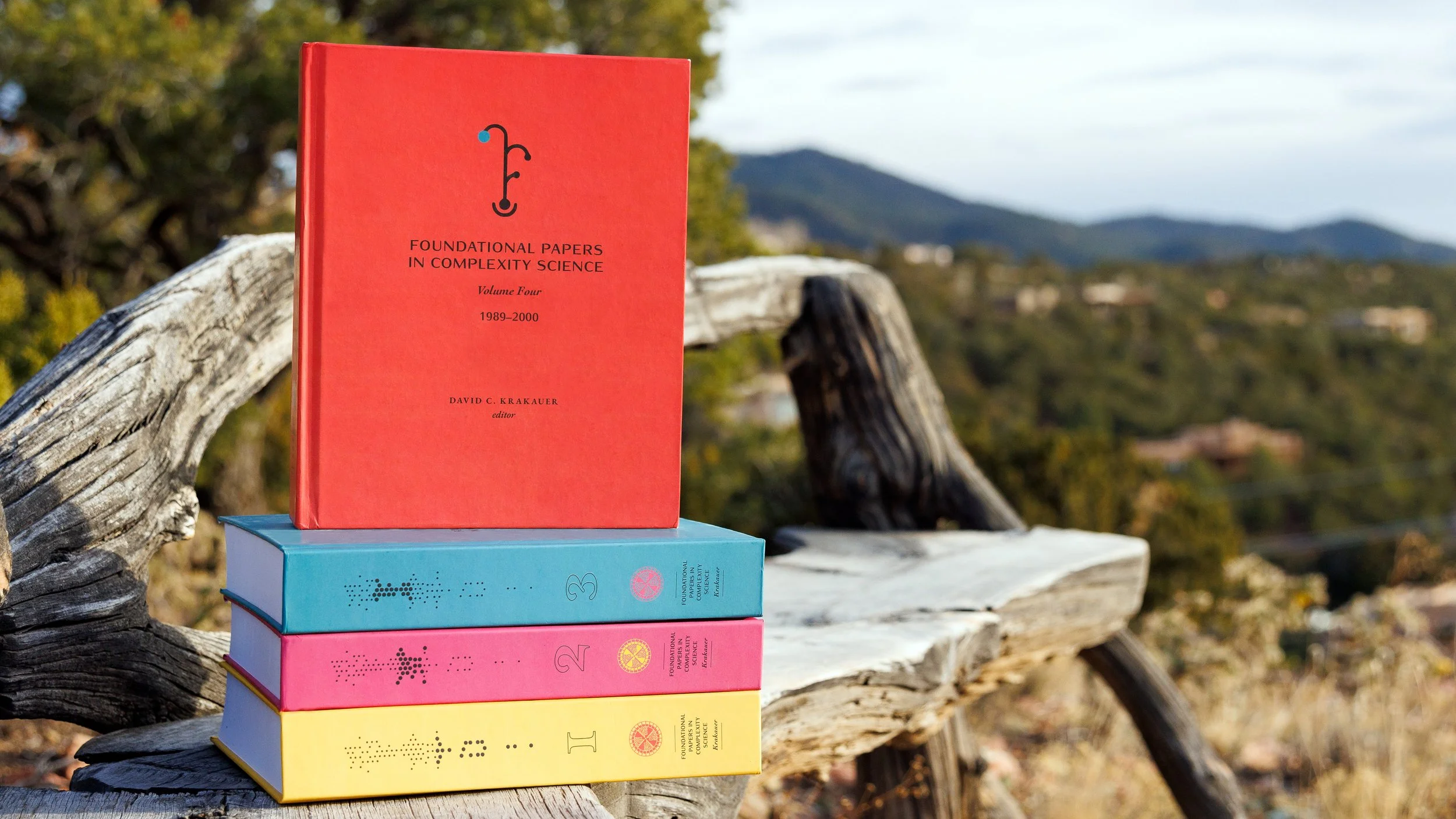
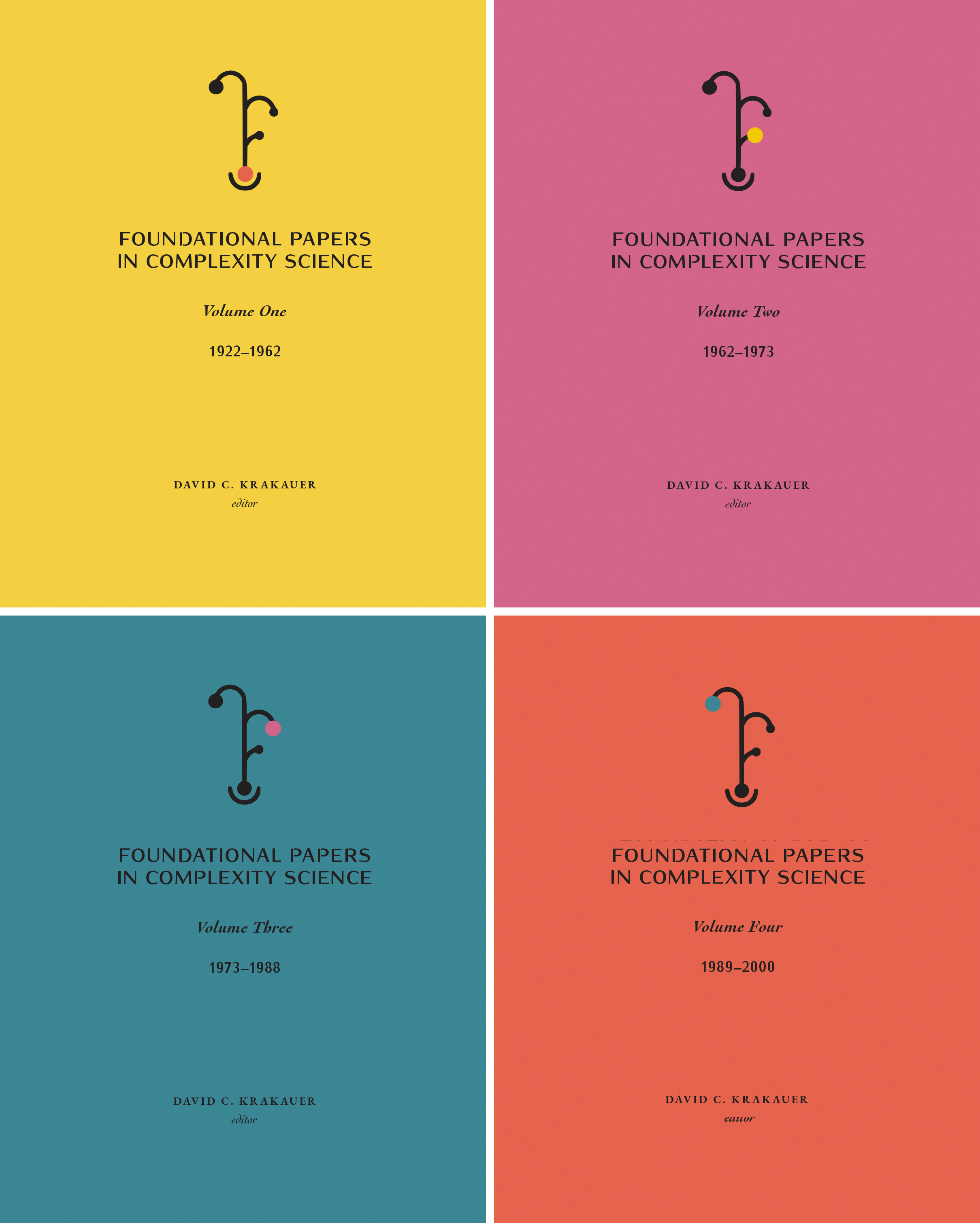
On December 19, the SFI Press published Volume 4 of Foundational Papers in Complexity Science. Following the publication of Volumes 1 and 2 in May and Volume 3 in September, this concluding book contains papers published between 1989 and 2000 — an era when complex-systems science had become a fledgling field of study in its own right. Hardcover and paperback versions of each book are available globally at cost; they are not available as ebooks due to electronic reprint rights.
We live in a complex world — one that is increasingly connected, evolving, technological, volatile, and potentially poised for catastrophe. And yet we continue to treat the world as if it were simple. Our dominant frameworks are still linear, unchanging, and disconnected, assuming Earth’s resources are infinitely exploitable. Complexity science offers a paradigm-shifting approach.
To SFI External Professor Han van der Maas, psychology is the most fascinating science of all. It’s also one he sees as facing multiple crises — crises of theory, replication, and measurement.
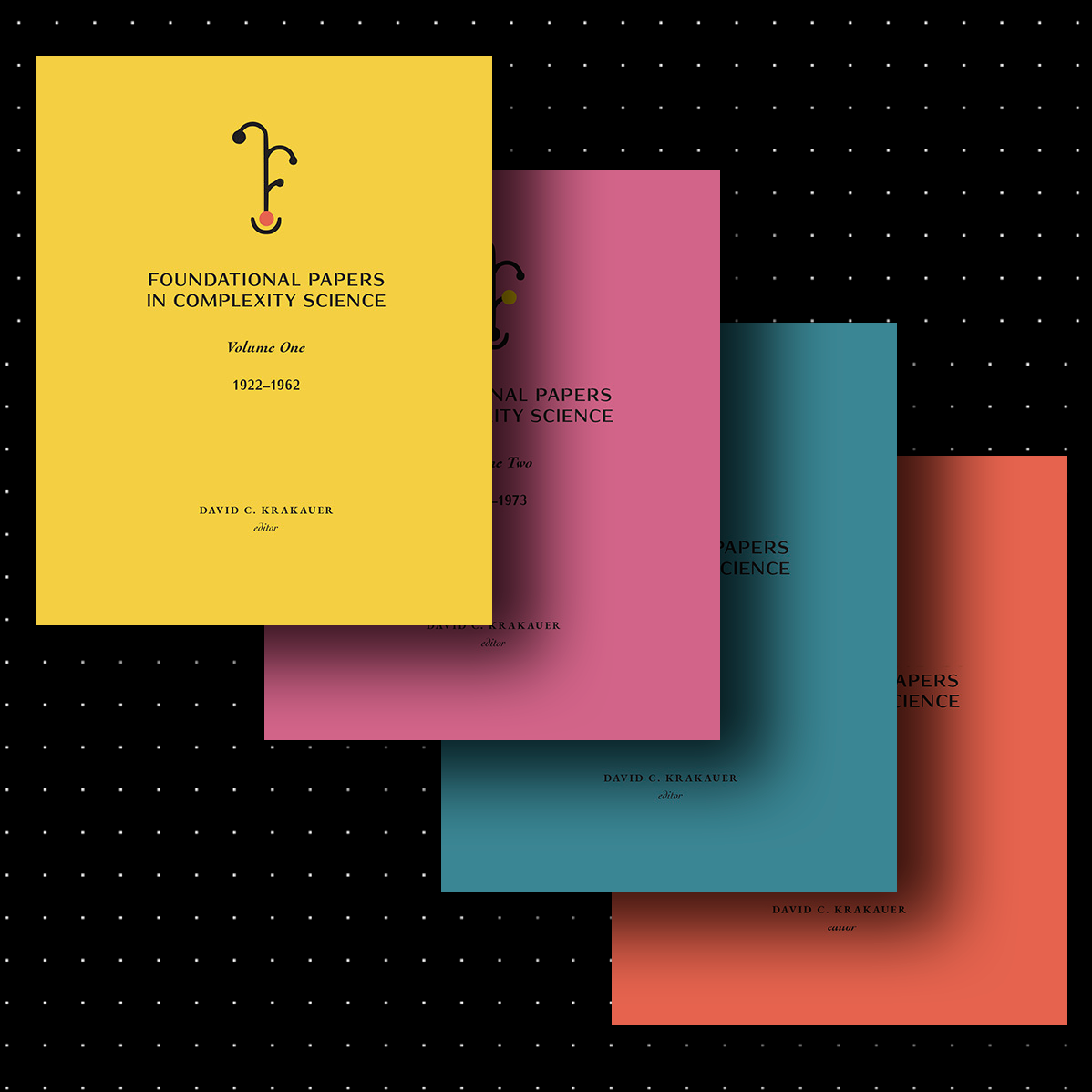
The Santa Fe Institute is gifting a set of Foundational Papers in Complexity Science books to each recipient of the Complex System Society’s upcoming Emerging Awards. The three winners will be announced during the next Conference on Complex Systems in Exeter, UK, in September.
When Claude Shannon wrote “A Mathematical Theory of Communication” in 1948, he was known as a mathematician and an electrical engineer. From this extraordinarily influential paper — cited more than 155,000 times — he would come to be called the “father of information theory.” Today, we see in him the hallmarks of an early complexity scientist.



The Complex World, originally published in Volume 1 of Foundational Papers in Complexity Science, presents an entirely new framing of nature, of the human role in the natural and technological worlds, and what it means to prosper on a living planet.
We live in a complex world—meaning one that is increasingly connected, evolving, technological, volatile, and potentially poised for catastrophe. And yet we continue to treat the world as if it were simple: linear, unchanging, disconnected, and infinitely exploitable.
Complexity science is an approach to understanding and surviving in a complex world. In this concise and comprehensive introduction, Santa Fe Institute President David C. Krakauer traces the roots of complexity science back to the nineteenth-century science of machines—evolved and engineered—into the twentieth-century science of emergent systems.
By combining insights from evolution, computation, nonlinear dynamics, and statistical physics, complexity science provides the first scientific framework for understanding the purposeful universe.